

Air is clean. No restrictions on outdoor activity.
India’s air, in one
honest number.
The official CPCB National AQI for every monitored city in India — read straight off the instrument, paired with what it means for your day.
PM2.5
234
Poor
CPCB National AQI
Illustrative sample · live readings coming soon
New Delhi
Delhi, India
Sub-indices
- PM2.5
234
- PM10
198
- NO₂
96
- SO₂
31
- CO
67
- O₃
54
Last 24 hours
212–248
Poor. Breathing discomfort likely on prolonged exposure. Sensitive groups should limit time outdoors.
Illustrative pre-launch sample · live CPCB readings coming soon
India, right now
The national picture
966
CPCB monitoring stations
CPCB network, Nov 2024
419
cities & towns covered
28 states + 7 UTs
121
average AQI across sampled cities (Moderate)
pre-launch sample
3
sampled cities at Poor or worse
pre-launch sample
What the number means
From Good to Severe, at a glance
India's CPCB scale runs 0–500 across six bands. The color is only ever shorthand for what the air does to you — here's the plain-language version.
Fine for most people. Unusually sensitive groups may notice minor discomfort.
People with asthma or heart and lung conditions should ease off prolonged outdoor exertion.
Breathing discomfort likely on prolonged exposure. Sensitive groups should limit time outdoors.
Respiratory effects likely on prolonged exposure. Keep outdoor activity short.
Affects healthy people too. Avoid outdoor exertion; sensitive groups should stay indoors.
How we read the air
From station to a single number
AQIRadar doesn't invent a score — it follows CPCB's official method, end to end. Here's the path every reading takes.
- 01
Stations measure the air
CPCB's national monitoring network samples six pollutants — PM2.5, PM10, NO₂, SO₂, CO and O₃ — hour by hour, at stations across India.
- 02
The worst pollutant sets the number
Each pollutant gets its own 0–500 sub-index. The highest one becomes the AQI, so the headline number always reflects your biggest exposure right now.
- 03
One number, one colour, one action
That value lands in a CPCB band — Good to Severe — each with a colour, a plain-language meaning, and what it means for your day outdoors.
The map
Every station, one view
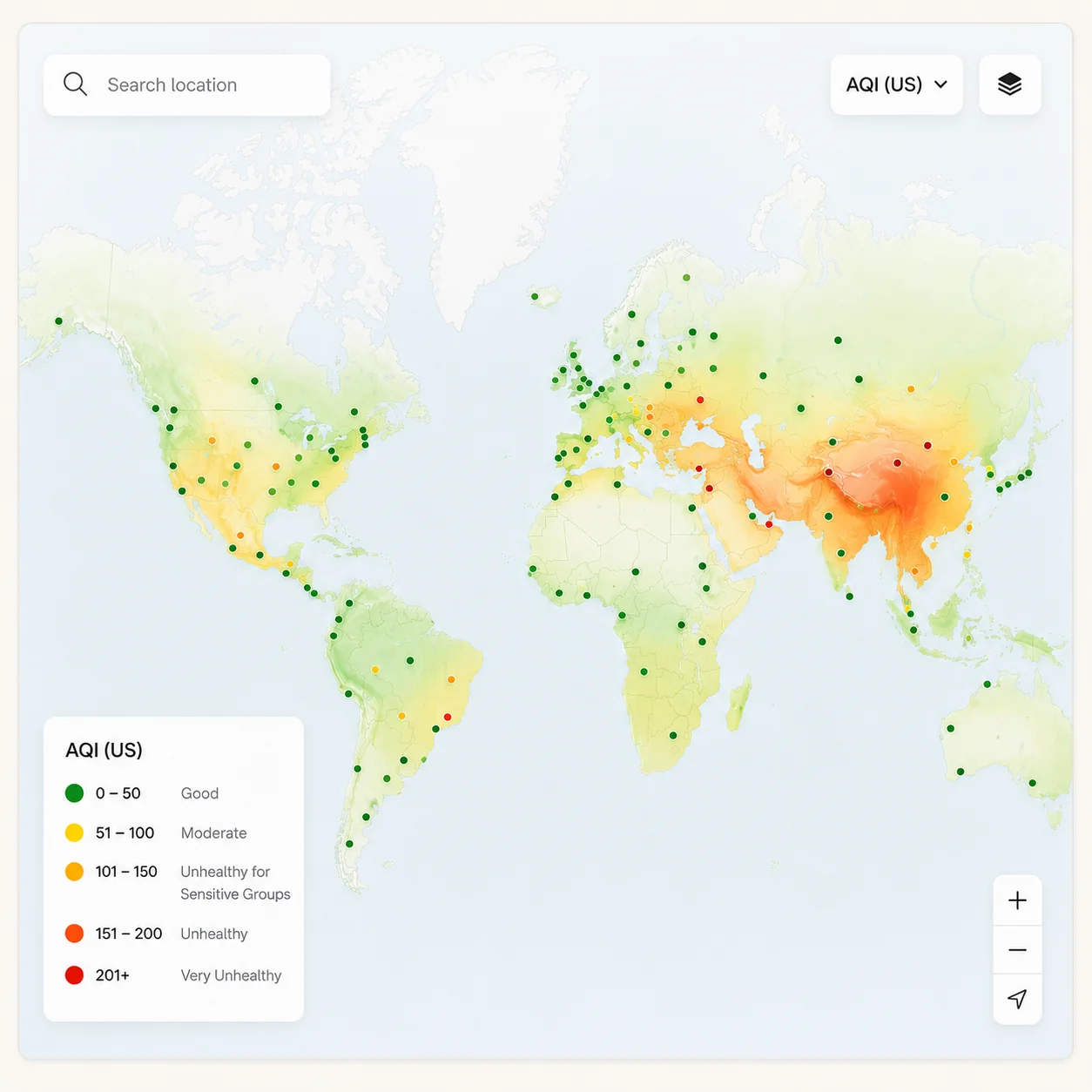
Station-level readings across the CPCB network, colored by category — and always paired with the value, never color alone.
- Good0–50
- Satisfactory51–100
- Moderate101–200
- Poor201–300
- Very Poor301–400
- Severe401–500
A pre-launch sample of 15 cities. The full interactive map — every station, live — is coming soon.
- New Delhi, Delhi: AQI 234, Poor
- Ghaziabad, Uttar Pradesh: AQI 221, Poor
- Faridabad, Haryana: AQI 209, Poor
- Rohtak, Haryana: AQI 197, Moderate
- Patna, Bihar: AQI 184, Moderate
- Kolkata, West Bengal: AQI 156, Moderate
- Mumbai, Maharashtra: AQI 142, Moderate
- Hyderabad, Telangana: AQI 103, Moderate
- Bengaluru, Karnataka: AQI 88, Satisfactory
- Chennai, Tamil Nadu: AQI 74, Satisfactory
- Kochi, Kerala: AQI 52, Satisfactory
- Imphal, Manipur: AQI 47, Good
- Madikeri, Karnataka: AQI 41, Good
- Shillong, Meghalaya: AQI 35, Good
- Aizawl, Mizoram: AQI 28, Good
Today's extremes
Most polluted & cleanest cities
A live leaderboard once the hourly CPCB feed lands — shown here with an illustrative pre-monsoon sample.
Most polluted right now
Highest AQI
- 1New DelhiDelhi · PM2.5Poor · 234
- 2GhaziabadUttar Pradesh · PM2.5Poor · 221
- 3FaridabadHaryana · PM2.5Poor · 209
- 4RohtakHaryana · PM10Moderate · 197
- 5PatnaBihar · PM2.5Moderate · 184
Cleanest right now
Lowest AQI
- 1AizawlMizoram · PM2.5Good · 28
- 2ShillongMeghalaya · PM2.5Good · 35
- 3MadikeriKarnataka · PM2.5Good · 41
- 4ImphalManipur · PM2.5Good · 47
- 5KochiKerala · PM2.5Satisfactory · 52
Understand the air
Know what the number means
Plain-language guides to the scale, the seasons, and the rules — written for India, not translated for it.
What is the CPCB National AQI?
One number, one color, one description — how India's official six-band scale works.
Read the guide →
India's seasons: stubble burning, Diwali & winter smog
Why October to January is different, and what drives Delhi-NCR into Severe.
Read the guide →
GRAP stages, explained
The Graded Response Action Plan — what each stage restricts and when it triggers.
Read the guide →
CPCB vs US AQI — why the number differs
Same air, different breakpoints. What changes when you toggle the standard.
Read the guide →
Questions
Frequently
asked
The short version of how the number works and where it comes from.
Read the full methodology →India's official air quality index: a single 0–500 number across six bands, from Good to Severe. It distills the day's dominant pollutant into one colour and one plain-language description — the government's “one number, one colour, one description” idea.
CPCB calculates a separate sub-index for each pollutant and takes the worst one as the AQI, so the headline number always reflects your biggest risk. AQIRadar still shows every sub-index in the live panel, so nothing is hidden.
Same pollutants, different breakpoints and category names — so the same air can read as a different number. AQIRadar reports India's official CPCB scale rather than converting it, so what you see matches CPCB and government advisories.
At launch, hourly — drawn from CPCB's monitoring network via data.gov.in. The values shown on this pre-launch page are an illustrative sample so you can see how the product reads.
No. The notes follow CPCB's category guidance for the general population. For personal advice — especially with asthma, heart or lung conditions — talk to a clinician. The AQI is a guide, not a diagnosis.
Live readings from CPCB via data.gov.in (Government Open Data License – India) and forecasts from Open-Meteo (CC BY 4.0). Both sources are credited in full in the footer.
How we measure
Live readings from CPCB’s national monitoring network via data.gov.in (GODL-India). Forecasts by Open-Meteo. Every reading is shown on India’s official CPCB National AQI scale. Methodology
- CPCB
- data.gov.in
- GODL-India
- Open-Meteo
Cities tracked include New Delhi, Ghaziabad, Faridabad, Rohtak, Patna, Kolkata, Mumbai, Hyderabad, Bengaluru, Chennai, Kochi, Imphal, Madikeri, Shillong, Aizawl and hundreds more.